Automotive OEMs have more data than ever.
Sales systems, dealer financials, customer experience platforms, audit tools, field-force reports and market data all generate information. Yet many executives still struggle to answer a simple question:
Where should we focus first?
The problem is rarely a lack of data.
It is fragmentation.
Different functions often operate with different systems, reporting cycles and definitions of performance.
Sales sees one version of the network.
Network Development sees another.
Customer Experience, Finance and Aftersales may each have their own view.
The result is a collection of reports rather than a connected picture of performance.
For OEM leadership teams, this creates a fundamental challenge: information may exist across the organisation without providing a clear view of what requires attention now.
A dealer may appear satisfactory on headline sales while showing weakening financial performance, declining customer experience or poor execution of key processes.
Looking at one measure in isolation can therefore hide an emerging performance issue.
The real opportunity is to understand how different indicators interact and where multiple signals point to the same underlying problem.
Before a dealer visit, an Area Manager may need to open several systems, download reports and interpret spreadsheets just to understand what is happening.
Time that should be spent discussing performance and agreeing actions can instead be spent finding and reconciling information.
A more connected approach gives field teams the context before the meeting begins.
When information needs to be consolidated across multiple systems and reporting cycles, management visibility can lag behind what is actually happening in the network.
By the time an issue appears in a consolidated report, the opportunity to intervene may already have passed.
The goal should therefore be more than reporting what happened.
It should be helping OEM teams understand what is happening, what matters and what needs to happen next.
The better model is a unified performance intelligence layer.
Rather than replacing every underlying system, OEMs can bring the most important measures together into one structured view.
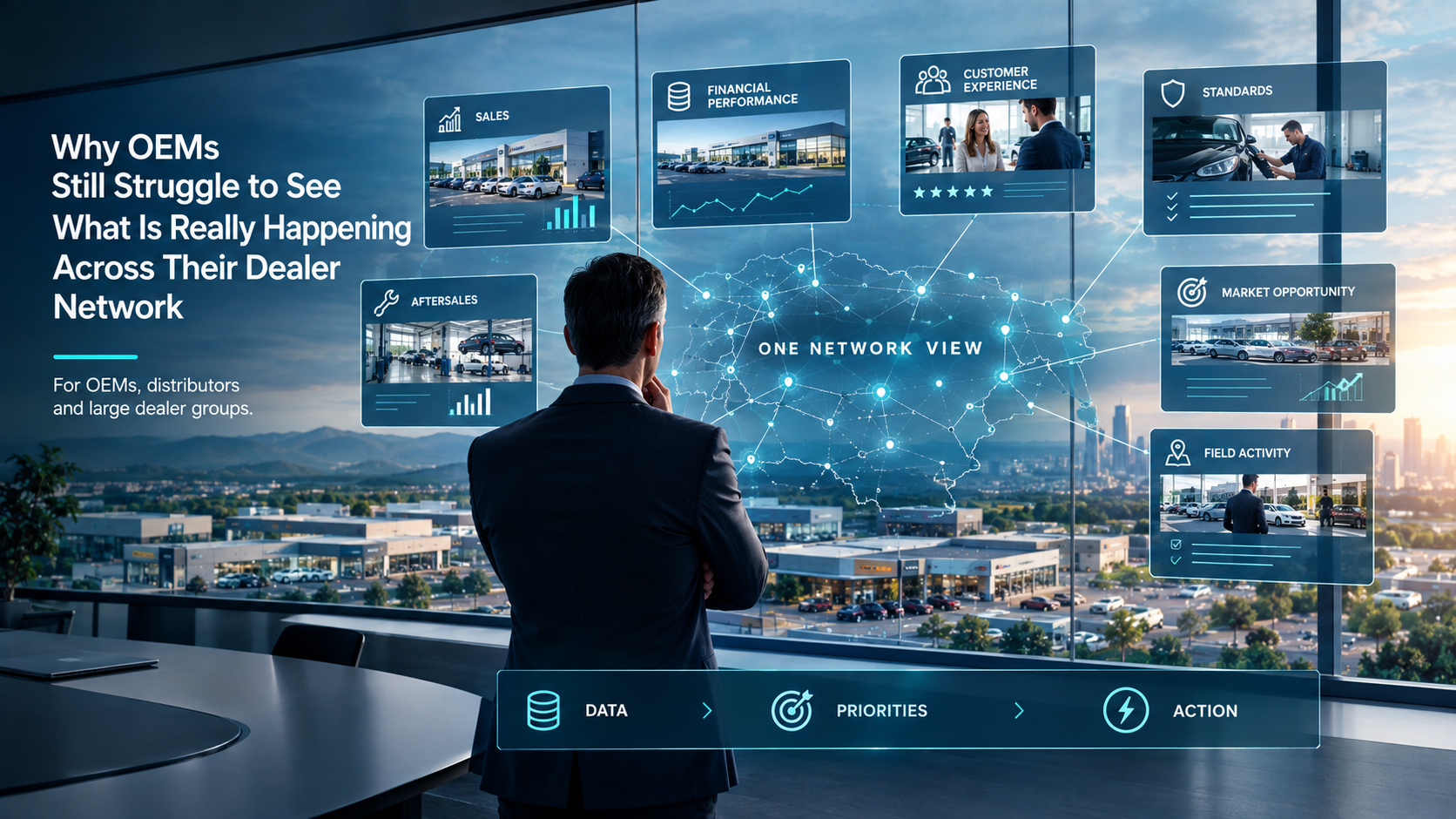
Sales performance can sit alongside dealer financials, customer experience, standards, market opportunity and field activity.
The objective is not to create another large dashboard.
It is to make priorities clearer.
A connected view can help answer questions such as:
This changes the management conversation from:
“What does the data say?”
to:
“What needs attention, why, and what are we going to do about it?”
For an OEM, the value of connected performance intelligence is not simply having more information on one screen.
It is creating a consistent view of the network.
A dealer profile can bring together relevant performance measures, historical trends, targets, actions and other information required to understand the business.
That gives OEM teams a common reference point when discussing performance with dealers.
It can also create greater consistency across the field organisation.
Instead of different Area Managers interpreting different reports, teams can work from a more structured view of performance and priorities.
This is particularly important across large networks, where differences in reporting practices can make it difficult to compare dealers, regions or markets consistently.
Visibility is only valuable when it leads to action.
A performance intelligence platform should therefore connect insights with the activities that follow.
For example:
Performance signal → Priority → Field action → Dealer discussion → Action plan → Follow-up → Measured outcome
This creates a closed loop between information and execution.
A field team can enter a dealer discussion already understanding the key issues, agree specific actions and then track progress rather than relying on disconnected meeting notes or spreadsheets.
The result is a shift from reporting performance to managing performance.
More dashboards do not necessarily solve the underlying problem.
If an OEM adds another dashboard without connecting the underlying measures, teams can simply end up with another place to look.
The more valuable approach is to connect the information that already exists and present it around the decisions the organisation needs to make.
That means designing around questions such as:
What is changing?
Where is the gap?
Why is it happening?
Who needs to act?
What action has been agreed?
Has performance improved?
This is where performance intelligence becomes different from conventional business reporting.
The purpose is not simply to display data.
The purpose is to help people decide and act.
Ri-focus is designed around this principle.
It brings together multiple dimensions of dealer and network performance so OEM teams can develop a more connected view of their network, identify gaps, prioritise opportunities and support dealers with better information.
Its capabilities include dealer profiles, performance insights, field activity, action tracking, comparisons and analytics.
For OEMs, this creates a structured connection between network visibility and field execution.
Rather than treating dealer data, field visits and action plans as separate activities, they can form part of the same performance management process.
The ultimate objective is not better reporting for its own sake.
It is better decision-making.
When OEM teams can see the network more clearly, they can spend less time searching for information and more time understanding what the information means.
That can support more focused dealer conversations, more consistent field activity and clearer accountability for agreed actions.
The same principle can apply across different parts of the organisation.
Sales can understand commercial performance.
Finance can understand financial indicators.
Customer Experience can identify areas requiring attention.
Aftersales can see relevant operational trends.
Network Development can understand broader dealer performance.
The value comes from connecting these perspectives rather than allowing each function to operate with a separate version of the network.
Automotive organisations will continue to generate more information.
The challenge is no longer simply collecting it.
It is turning that information into a clear understanding of where attention is required.
For OEMs, distributors and large dealer groups, a connected performance intelligence approach can help bridge the gap between data, decision-making and field execution.
The question is no longer:
“Do we have the data?”
It is:
“Can our teams see what matters, act on it and measure what happens next?”
That is where performance intelligence can create real value across a dealer network.
The value of dealer network data is not how much an OEM can collect. It is how quickly that information can become a clear priority, a focused action and a measurable outcome.
For OEMs and distributors, the opportunity is to move beyond disconnected reporting and create a more unified view of dealer performance—one that helps leadership teams see the network clearly and helps field teams act with greater confidence.
Ri-focus is Op2ma’s modular automotive performance intelligence platform, helping OEMs and distributors bring network information together, identify priorities and turn insight into action.
To discuss Ri-focus, contact Tim McGrath on +61 409 900 130.