
Primary audience: Automotive financiers
Secondary audience: OEM sales and dealer operations
Contract maturity is easy to identify, which is why so many retention programmes are built around it.
But waiting until the final months of a finance contract can mean entering the conversation after the customer has already researched alternatives, visited another showroom or started thinking about what comes next.
The better question is not simply:
“When does the contract end?”
It is:
“When does this customer have a credible reason to consider what comes next?”
The difference is important.
A maturity date tells you when a contract finishes. It does not necessarily tell you when a customer becomes commercially relevant.
Customer circumstances, vehicle equity, finance position and ownership needs can change well before the contract reaches its final months. For financiers, recognising those changes creates an opportunity to start a more relevant conversation earlier.
Retention should therefore be viewed as a series of potential moments throughout the customer lifecycle, rather than a single date on a contract.
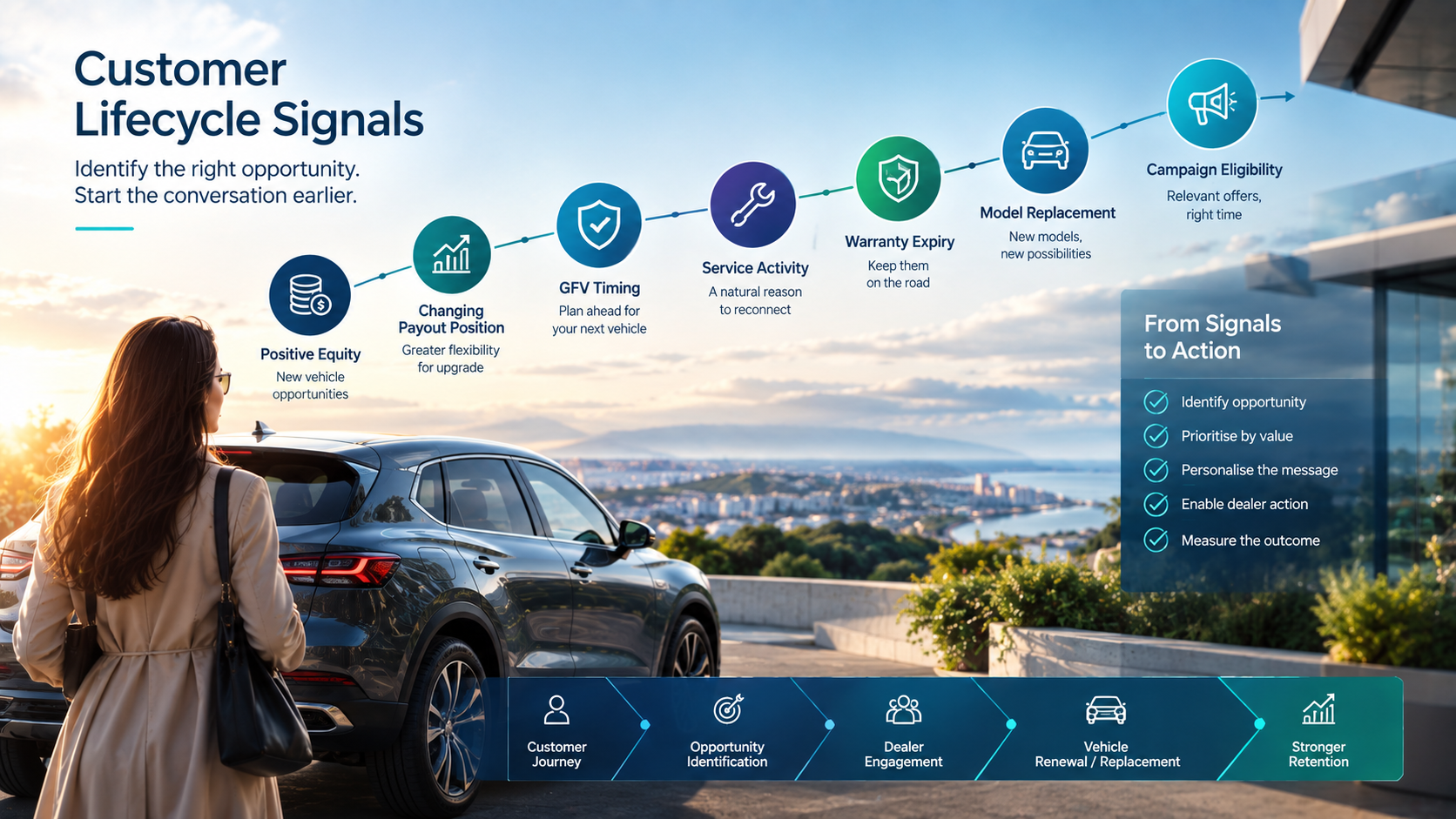
Positive equity, a changing payout position, GFV inspection timing, warranty expiry, service activity, model replacement and campaign eligibility can all indicate an emerging opportunity.
Individually, these signals may not tell the whole story.
Together, they can provide a much clearer picture of when a customer may be ready for a new conversation.
Used well, lifecycle signals make outreach feel helpful rather than arbitrary.
The customer receives a reason to engage.
The dealer receives the context needed to hold a useful conversation.
And the financier gains a more informed view of where future renewal opportunities may exist.
This is where customer and finance data becomes commercially valuable.
Rather than simply asking a dealer to contact a customer because their contract is approaching maturity, the dealer can be given a clearer reason for the conversation:
The objective is not to contact customers earlier simply for the sake of being earlier.
It is to contact them when there is a credible reason to engage.
More alerts do not automatically create better retention.
If every customer becomes an opportunity, dealer teams simply receive another undifferentiated lead list. As the volume increases, attention can fall quickly.
Effective retention requires prioritisation.
Each opportunity should be considered according to factors such as:
This allows dealer teams to focus on the opportunities where there is a clear reason to act.
A smaller, well-explained action list can be more valuable than a large file containing thousands of customers with no clear priority.
The difference is between data distribution and commercial intelligence.
Data tells a dealer who is in the portfolio.
Intelligence helps explain who to contact, why now and what conversation to have.
For financiers, this distinction can make retention programmes more practical for dealer networks and easier to measure.
Identifying an opportunity is only the beginning.
The next challenge is coordinating what happens afterwards.
An effective retention journey may include an initial digital message, a measured response window, a dealer task, a follow-up reminder and, where appropriate, an escalation path.
The sequence should also recognise what has already happened.
If the customer has responded, the journey should adapt.
If an appointment has been booked, unnecessary communications should stop.
If the customer has declined contact, the next action should reflect that decision.
If the dealer has already spoken with the customer, the system should not create another disconnected task.
This matters because customers can interact with multiple organisations throughout the ownership journey.
The financier may communicate with them.
The OEM may communicate with them.
The dealer may contact them.
Without coordination, the customer can receive multiple messages about the same vehicle or finance relationship without any of the participants having a complete view of the interaction.
A connected retention model reduces this duplication.
It creates a more coordinated journey where the financier, OEM and dealer can work from the same opportunity and understand what action has already taken place.
Financiers do not need to activate every possible lifecycle signal on day one.
In fact, trying to do everything immediately can make a retention programme unnecessarily complex.
A more practical starting point is to identify two or three high-value moments.
Identify customers approaching a meaningful GFV milestone and create a structured pathway towards renewal, replacement or another relevant conversation.
Identify customers whose vehicle position may create an opportunity for a new vehicle conversation before their existing contract reaches maturity.
Maintain the traditional maturity trigger, but use it as one part of the broader lifecycle rather than the entire retention strategy.
For each signal, define:
Once the operating model works, additional signals can be introduced with greater confidence.
This creates a scalable approach rather than an increasingly complicated collection of alerts.
The value of lifecycle data is ultimately determined by what happens after an opportunity is identified.
A retention programme should connect the signal to an action.
Signal → Opportunity → Prioritisation → Customer Communication → Dealer Action → Appointment → Vehicle Sale → Finance Renewal
Each stage provides another point at which performance can be measured.
This also changes how financiers can evaluate retention.
Instead of simply measuring how many customers were identified, the organisation can understand how many opportunities progressed, how many customers engaged, how many appointments were created and how many ultimately renewed or replaced their vehicle.
The result is a clearer connection between customer intelligence and commercial performance.
This is where solutions such as Ri-gnr8 can support a more connected approach, bringing together finance-book data, customer opportunities and dealer activity to help identify and act on relevant retention opportunities.
The most valuable retention opportunity may occur well before the contract maturity date.
A customer who has positive equity, an approaching GFV milestone, a changing vehicle requirement or another relevant lifecycle signal may already have a reason to consider their next vehicle.
Waiting for the maturity date can mean waiting until the customer is already considering other options.
Starting earlier does not mean contacting customers more frequently.
It means understanding when relevance begins.
The strongest retention programmes identify those moments, prioritise them intelligently and coordinate the actions that follow.
That gives dealers a better reason to engage, customers a more relevant conversation and financiers a clearer view of the future renewal pipeline.
The best retention moment is when customer relevance and commercial opportunity overlap—not simply when a calendar reaches a prescribed date.
For automotive financiers, the opportunity is to move beyond maturity-based campaigns and build a lifecycle approach that identifies meaningful signals earlier, prioritises the right customers and gives dealer teams the context to act.
The result is not simply earlier contact.
It is better-timed, more relevant and more measurable customer conversations.
Talk to Ann Cawkwell at Op2ma on +61 419 854 970.
Explore Op2ma’s solutions for financiers and discover how connected data, customer intelligence and dealer action can support a stronger retention programme.