For OEMs, distributors and large dealer groups
OEM field teams are expected to influence dealer performance across sales, aftersales, customer experience, standards and profitability. Yet in many organisations, the tools provided to them have not kept pace with the complexity of the role.
Spreadsheets, static reports and disconnected dashboards remain common. They may contain useful information, but they place the burden of interpretation on the field person.
That is a productivity problem.
Before a dealer visit, a field manager should not have to spend hours collecting data from multiple sources. During the visit, they should not be searching through reports to establish which issues matter. After the visit, agreed actions should not disappear into meeting notes or personal spreadsheets.
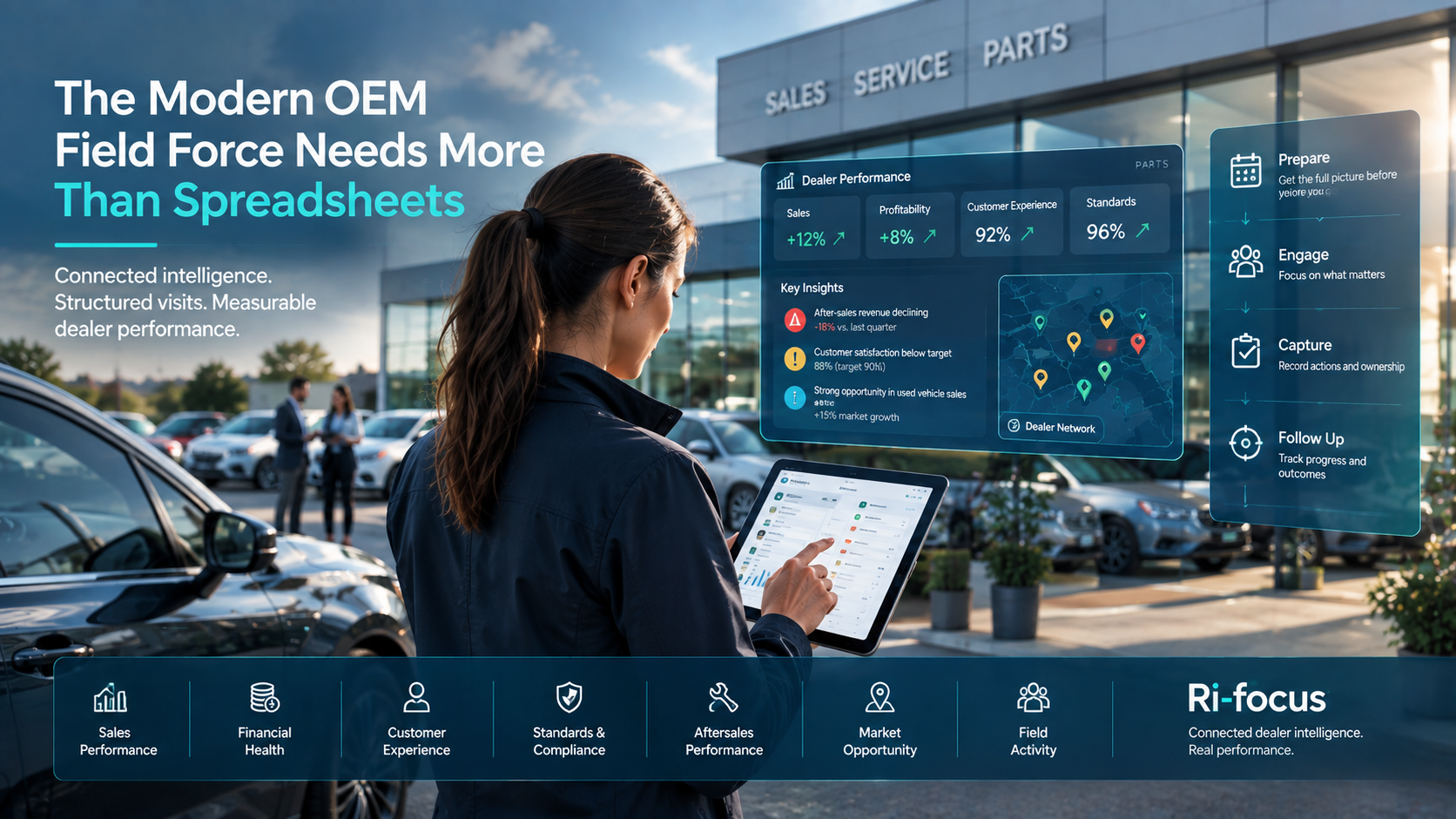
A modern field-force platform should support the complete performance conversation.
A productive dealer visit starts before the field manager arrives.
The team needs a clear view of relevant dealer performance, recent trends, outstanding actions and areas that may require attention.
Instead of opening multiple systems and manually assembling information, the field manager should be able to prepare from one structured view.
This is where dealer network performance intelligence can make a practical difference.
A connected platform can bring relevant sales, financial, customer experience, standards and operational information together so field teams can focus their preparation on the issues that matter most.
The objective is not simply to give field teams more information.
It is to give them better context before the conversation begins.
During a dealer visit, the focus should be on understanding performance, discussing opportunities and agreeing what happens next.
Yet when information is scattered across reports, a significant amount of time can be spent finding the numbers needed to support the conversation.
A modern field-force platform should make the information accessible when it is needed.
It should help highlight:
This changes the role of the field manager.
Instead of becoming a report interpreter, they can spend more time acting as a performance partner to the dealer.
The value of a dealer visit does not end when the meeting finishes.
The most important question is:
What happens next?
A modern field-force platform should allow the team to capture the discussion, agree actions, assign accountability and establish follow-up.
The process can be as simple as:
Identify → Discuss → Agree → Assign → Track → Review
This creates a clear connection between the issue identified during the visit and the action required to address it.
It also creates greater visibility for management.
Instead of relying on individual spreadsheets, emails or meeting notes, OEM leadership can see which actions have been created, who owns them and whether they are progressing.
Dealer performance improvement often requires multiple conversations.
An issue identified during one visit may require additional support, another discussion or a review of progress at the next visit.
Without structured tracking, actions can become difficult to follow up.
A connected field-force platform can provide reminders, action tracking and visibility of outstanding tasks, helping teams maintain continuity between visits.
This is particularly valuable across large dealer networks where multiple field representatives may interact with different dealers and where management needs a consistent view of progress.
The goal is not to create more administration.
It is to make the administration that already exists structured, visible and useful.
There is another benefit to digitising field activity.
When dealer visits are structured consistently, the organisation can begin to see themes across the network.
Management can identify:
This creates a feedback loop between the field and the organisation.
The field team gains better tools to manage individual dealer conversations.
Management gains a clearer view of what is happening across the network.
And the organisation can use those insights to determine where broader intervention may be required.
The broader shift towards digital field operations is not simply about replacing paper with software.
Research into field operations has highlighted how digital tools can help teams automate manual processes, integrate information and improve how field activity is managed.
For automotive OEMs, the same principle applies.
The objective should be to connect the information, workflow and actions that already form part of the field team’s role.
That means giving field managers:
Relevant intelligence before the visit.
A structured environment during the visit.
Clear actions and accountability afterwards.
When those elements are connected, technology becomes an enabler of better dealer conversations rather than another reporting system.
Ri-focus is designed around this connected approach.
The platform brings together dealer performance information, field activity, structured visits and action planning so OEM teams can prepare more effectively, manage dealer conversations and maintain visibility of agreed actions.
Ri-focus is built to help OEMs move from fragmented reporting towards a more connected approach to dealer network performance.
Its broader platform brings together network performance visibility, structured field visits and action plans, operational and financial insights, and accountability across dealer activity.
For OEM teams dealing with dealer standards and compliance, Ri-focus Audit extends the same principle into structured assessments, action tracking and network-level visibility.
For OEM executives, the benefit extends beyond saving field teams time.
A more connected field-force process can create greater consistency in how the network is managed.
Every field manager can work from a clearer performance picture.
Dealer conversations can follow a more structured process.
Actions can be assigned and tracked.
And management can gain visibility into the themes emerging across the network.
This creates a stronger connection between field activity and dealer performance.
The question is no longer whether the organisation has enough reports.
It is whether the field team has the tools to turn those reports into focused conversations, measurable actions and performance improvement.
Spreadsheets will always have a place in business.
But they should not be the operating system for a modern OEM field force.
When field teams are responsible for influencing multiple dimensions of dealer performance, they need tools that bring information, conversations and actions together.
The strongest field-force model is not:
Report → Visit → Report
It is:
Intelligence → Conversation → Action → Follow-up → Improvement
That is the shift from field reporting to field performance management.
The modern OEM field force does not need more reports. It needs the right intelligence at the right time, a structured way to manage dealer conversations and clear visibility of what happens next.
For OEMs and distributors, the opportunity is to give field teams the tools to spend less time assembling information and more time helping dealers improve performance.
Ri-focus is Op2ma’s modular automotive performance intelligence platform, helping OEMs and distributors bring network information together, identify priorities and turn insight into action.
To discuss Ri-focus, contact Tim McGrath on +61 409 900 130.